Hayek and Yabe wrote this article after a shared unique writing experience of translingual online writing. Upon trying to complete her dissertation, Yabe (a deaf writer) reached out to Hayek (a hearing editor) to edit and help her complete her it. Along their journey they discovered that they were a part of a complex system. They then Syverson’s Ecology of Composition Matrix to help them understand why and how their online collaborative writing process was so effective. Hayek and Yabe describe the four attributes and the five dimension of complex theory and how their experience fit into the matrix. Using Google Docs for their collaborative sessions revealed how effective their system was at adapting, sharing and emerging new self-organizing processes and behaviors.
While reading the article I had to conduct some background information on complex theory and on ecology of composition in order to understand why Hayek and Yabe used this to understand their writing experience. Hayek and Yabe didn’t offer much background information on complexity theory, on Syverson’s ecology of composition or on how they came to choose Syverson’s theory to understand their unique writing situation. This lack of information led me to doing some research on my own. To begin, complex theory is interesting in the way that it offers a framework for modeling, studying, and analyzing complex systems in the abstract. Complex Systems are systems that are composed of many components where a network of independent agents are interconnected and interact with one another. Ecology is an example of a complex system. For instance, there can be an ecology of plants or and ecology of the food chain. Syverson proposed the theory that there can be also an ecology of composition. She claimed that composition is a complex system because it consists of a network of independent agents that are interconnected and interact with one another. The independent agents in composition consist of the readers, writers, audience, and the entire writing process. Each agent and each stage of the writing process interact with one another and are interconnected. Syverson then went on to create this matrix:
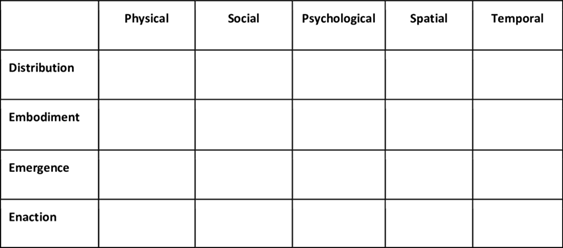
Hayek and Yabe explain the gaps in previous studies that they hope to address in their unique writing situation. However, I feel as though they failed to expressly explain why they chose Syverson’s Ecology of Composition Matrix to explain their writing situation. I also wonder if they attempted to use other theories and models before deciding on Syverson’s model. Having to do much of the background research on my own I came to understand why they chose Syverson’s model. Although I was able to come to this understanding, I was still left feeling that they failed to supply enough detailed information about their situation and how it fits into the Syverson matrix.
Unlike Syverson’s original theory, Hayek and Yabe’s writing situation is placed in digital space which is why I really appreciate this article. Much of today’s writing takes place in the digital space, whether it’s personal, professional, academic writing, etc. Right now in the pandemic that we are experiencing, many people (students, teachers, workers etc.) have had to adapt to working in digital space. I think of my own situation (both personally and professionally). Personally and professionally my classes have moved online. In my professional life all of my students must now complete all of their work in the digital space and even attend virtual classes. This the perfect example of a complex system similar to Hayek and Yabe’s. The difference being though, Hayek and Yabe were able to meet in person and virtually at the same time. Now, all of my meetings and classes are taking place only virtually.
Just like Syverson hypothesized and just like Hayek and Yabe’s situation, this complex composition system I find myself in follows the four attributes. Work is distributed and divided to the students, students then come to embody this new role and from their new roles emerge new behaviors, new thought processes, and etc. These new behaviors are enacted and adapted through the technology being used. For example, handing in work on time on google classroom, attending online/virtual classes, attending office hours online and so on.
The five dimensions of complex theory also fit this complex situation. The physical material would be the document, text, or classwork assignment being used. The social dimension is the interaction that takes place between the students themselves, the students and teachers, teachers and administration, the administration team, and even with outside figures such as the department of education, the state, etc. Psychologically all agents in this system must adapt to this new way of learning online and virtually. In Hayek and Yabe’s situation psychologically their cognitive process were changed because they were able to communicate with one another directly through a google document chat and not through an interpreter. Their cognitive processes were also changed because before the session each person had an established role. Hayek was the editor and Yabe was the writer. However, when they came together both embodied the role of reader and editor. They would actively read the document together, making changes simultaneously. Hayek and Yabe were bounded by digital space and physical space, students in this situation are bounded just by digital space. For the temporal dimension, times in this new situation have changed and adapted. Students now have time deadlines on specific days and virtual classes are must shorter than they were in person. I offer feedback either directly on their assignment or when we speak virtually during online office hours. From this unique complex situation/system, all agents involved have adapted and created a new self-organizing process for themselves.
I found Hayek and Yabe’s situation to be rather compelling once I fully understood the background information surrounding them. Their situation can be applied to many complex composition situations as an ecology. They place a lot of their focus on google docs because that is the platform they used, but I think it can be pushed far beyond that. For example, you can use the complex theory on ecology of composition when studying how teachers offer feedback to students and how those students take and utilize that feedback. This theory can be also used when studying the writing process in a freshman composition class. The translingualism that took place in Hayek and Yabe’s situation was also unique, but it can also apply to many other complex composition situations. There are individuals that speak one or multiple languages. Or it can be used in a situation where one must translate work or write in a language different from their own.
Whenever there is a complex composition situation and you want to study how the different interactions of the components involved can result in the emergence of stable patterns, you can use this theory. I will not be using Ecology of Composition or complexity theory in my own research, but I can defiantly see the benefits of this theory.
 Composition Studies: Research and Methods