I found it extremely helpful to be read a breakdown of the different research approaches/methods. Methodology is the foundation of research and your research is only as good as its foundation. A strong foundation will help lead to strong research, while a weak foundation can have the opposite result. The breakdown provided in the article was extremely helpful when trying to decide which methodology will work with your research.
Phenomenology: When you want to describe the experience of a phenomenon.
Discourse Analysis: When want you to understand how discourse shapes people and society.
Grounded Theory: When you want to answer a question and don’t have a hypothesis, the data drives the understanding and theory.
When I began my research proposal I was leaning towards using grounded theory. I don’t have a hypothesis, I will be using grounded theory to investigate the use of Ebonics inside a class and how a students’ academic growth is impacted. The categories will come from the data and will include teacher’s and student’s attitudes, motivation, reflections and so on.
The Study: This study consisted of 8 out of 13 graduate students taking a discourse class. The purpose of the study was to measure the students different levels of uniqueness seeking and see how students who have different for uniqueness will perform in an online discussion for collaborative meaning-making.
My Thoughts: Who knew that this article would be so relevant at this time? During this pandemic we’ve had to make the shift from in-person classes to online classes. Some people take to online learning, while others may struggle a little. Either way I don’t think that the experience of online learning or having online discussions, is the same as being in person.
This study not only had me thinking about my own “uniqueness-seeking needs” but also those of my students. There are many pros and cons in our current situation. For example, in my classes there are students who were too shy to be called on now contributing to discussions more. I also see students who were very easily distracted in class, now being in their own homes working diligently online, completing assignments and handing them in on time. On the negative side, it has become increasingly difficult to gauge whether or not students fully grasp the material, and some students are slacking.
The article itself was simple and confusing at the same time (if that makes any sense). The article was simplistic an easy to read, but some of their methods and findings were difficult to understand. They accounted for many things such as gender and culture, but I think there are many more factors surrounding individual students that should have been included.
In this article, Ferenz used a case study and phenomenology to investigate the role a L2’s social environment plays in developing their academic literacy within an EFL setting. Ferenz studies the types of relationships formed and the impact these relationships have on the acquisition of L2 advanced academic literacy. The study took place at a large university in Israel. The interviews and data came from six participants. Two of them had PhDs, four of them had MA degrees, 5 of them spoke the native language (Hebrew) and 1 spoke Russian. I think if Ferenz would have sued a larger study size, that were more diverse, more results and data could have emerged from this study.
In my opinion, the most important investigation in this essay was Ferez’s investiagion into how the relationships that EFL students create impact their acquisition of L2 academic literacy and writing. It is important to make note that students need to create social networks and relationships in order to obtain L2 academic literacy and writing. However, it is equally important to know that an EFL student’s acquisition of L2 academic literacy and writing depends greatly on the social network and relationship. A strong relationship will most likely result in high L2 academic literacy, while a weaker relationship may result in weak L2 academic literacy. Good relationships will be favorable for the student in thier journey to achieve L2 academic literacy.
As vital the relationships created are, it is important to also take into account the independent student and their determination, motivation, goals, etc. In the article’s conclusion, Ferenz stated, that, “the participants’ identities and goals appear to impact the nature of their social networks which in turn influence each student’s L2 AAL acquisition” (349). A student’s individual goal will determine what they take out of the class, but I think if the social network created is strong then the student’s goal doesn’t stop them from acquiring the necessary academic information and/or literacy. For example, in our research class each one of us has a different research question and we are using different methodologies. The methodology I may be using may not work for the next person but at the end of the day we all had to learn about each methodology in order to decide which one would work for us.
My study is a continuation of a topic I explored in Dr. Zamora’s Writing Theory & Practice class where during our final project my fellow classmates and I created a website as a blueprint for using your voice in writing. One of the many topics we discussed included code-switching and how necessary it is for many people. Being an African American and knowing first hand the importance of code-switching I wanted to remind other Ebonics users and African American students that code-switching did not mean they needed to erase their voices. Code-switching was just the vehicle they used to transform their voice into the language society has deemed to be “appropriate”.
Fast-forward to Dr. Nelson’s Research & Methods class, the task of finding a research topic was daunting at first. Dr. Nelson prompted me to think about what is important to me and I thought back to the topic I wrote last semester. However, I had no idea how to turn this topic into a research question. I re-read my essay and my story really stuck with me. The struggles I initially faced when my Ebonics was corrected was extremely challenging. This led me to think about the many African American students who also use Ebonics and how they are being taught. This was rather a long journey but it finally led me to (with the help of Dr. Nelson) to formulating my research question: How does a teacher’s stereotypes, opinions or preconceptions of students who use Ebonics impact a student’s academic growth?
I chose to focus primarily on students because although ELL may have similar experiences in school, unlike most other languages that ELL students use, Ebonics has not been widely considered as an official language. The literature review on this topic shows that there are studies dedicated to examining the use of Ebonics and it’s contribution to the achievement gap for African American students. But if you’re going to study the trend of students who use Ebonics and measure their academic success, you should also investigate the academic care these students receive while in school. My research proposal has the potential to inform and improve teacher attitudes and pedagogy which could assist in closing the achievement and academic success gap for many minority students.
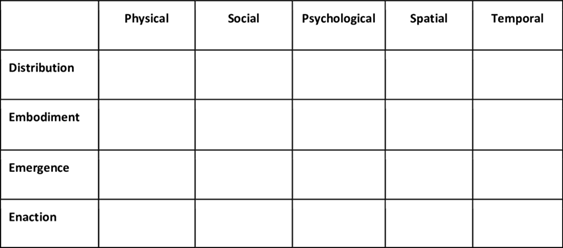
Hayek and Yabe wrote this article after a shared unique writing experience of translingual online writing. Upon trying to complete her dissertation, Yabe (a deaf writer) reached out to Hayek (a hearing editor) to edit and help her complete her it. Along their journey they discovered that they were a part of a complex system. They then Syverson’s Ecology of Composition Matrix to help them understand why and how their online collaborative writing process was so effective. Hayek and Yabe describe the four attributes and the five dimension of complex theory and how their experience fit into the matrix. Using Google Docs for their collaborative sessions revealed how effective their system was at adapting, sharing and emerging new self-organizing processes and behaviors.
While reading the article I had to conduct some background information on complex theory and on ecology of composition in order to understand why Hayek and Yabe used this to understand their writing experience. Hayek and Yabe didn’t offer much background information on complexity theory, on Syverson’s ecology of composition or on how they came to choose Syverson’s theory to understand their unique writing situation. This lack of information led me to doing some research on my own. To begin, complex theory is interesting in the way that it offers a framework for modeling, studying, and analyzing complex systems in the abstract. Complex Systems are systems that are composed of many components where a network of independent agents are interconnected and interact with one another. Ecology is an example of a complex system. For instance, there can be an ecology of plants or and ecology of the food chain. Syverson proposed the theory that there can be also an ecology of composition. She claimed that composition is a complex system because it consists of a network of independent agents that are interconnected and interact with one another. The independent agents in composition consist of the readers, writers, audience, and the entire writing process. Each agent and each stage of the writing process interact with one another and are interconnected. Syverson then went on to create this matrix:
Hayek and Yabe explain the gaps in previous studies that they hope to address in their unique writing situation. However, I feel as though they failed to expressly explain why they chose Syverson’s Ecology of Composition Matrix to explain their writing situation. I also wonder if they attempted to use other theories and models before deciding on Syverson’s model. Having to do much of the background research on my own I came to understand why they chose Syverson’s model. Although I was able to come to this understanding, I was still left feeling that they failed to supply enough detailed information about their situation and how it fits into the Syverson matrix.
Unlike Syverson’s original theory, Hayek and Yabe’s writing situation is placed in digital space which is why I really appreciate this article. Much of today’s writing takes place in the digital space, whether it’s personal, professional, academic writing, etc. Right now in the pandemic that we are experiencing, many people (students, teachers, workers etc.) have had to adapt to working in digital space. I think of my own situation (both personally and professionally). Personally and professionally my classes have moved online. In my professional life all of my students must now complete all of their work in the digital space and even attend virtual classes. This the perfect example of a complex system similar to Hayek and Yabe’s. The difference being though, Hayek and Yabe were able to meet in person and virtually at the same time. Now, all of my meetings and classes are taking place only virtually.
Just like Syverson hypothesized and just like Hayek and Yabe’s situation, this complex composition system I find myself in follows the four attributes. Work is distributed and divided to the students, students then come to embody this new role and from their new roles emerge new behaviors, new thought processes, and etc. These new behaviors are enacted and adapted through the technology being used. For example, handing in work on time on google classroom, attending online/virtual classes, attending office hours online and so on.
The five dimensions of complex theory also fit this complex situation. The physical material would be the document, text, or classwork assignment being used. The social dimension is the interaction that takes place between the students themselves, the students and teachers, teachers and administration, the administration team, and even with outside figures such as the department of education, the state, etc. Psychologically all agents in this system must adapt to this new way of learning online and virtually. In Hayek and Yabe’s situation psychologically their cognitive process were changed because they were able to communicate with one another directly through a google document chat and not through an interpreter. Their cognitive processes were also changed because before the session each person had an established role. Hayek was the editor and Yabe was the writer. However, when they came together both embodied the role of reader and editor. They would actively read the document together, making changes simultaneously. Hayek and Yabe were bounded by digital space and physical space, students in this situation are bounded just by digital space. For the temporal dimension, times in this new situation have changed and adapted. Students now have time deadlines on specific days and virtual classes are must shorter than they were in person. I offer feedback either directly on their assignment or when we speak virtually during online office hours. From this unique complex situation/system, all agents involved have adapted and created a new self-organizing process for themselves.
I found Hayek and Yabe’s situation to be rather compelling once I fully understood the background information surrounding them. Their situation can be applied to many complex composition situations as an ecology. They place a lot of their focus on google docs because that is the platform they used, but I think it can be pushed far beyond that. For example, you can use the complex theory on ecology of composition when studying how teachers offer feedback to students and how those students take and utilize that feedback. This theory can be also used when studying the writing process in a freshman composition class. The translingualism that took place in Hayek and Yabe’s situation was also unique, but it can also apply to many other complex composition situations. There are individuals that speak one or multiple languages. Or it can be used in a situation where one must translate work or write in a language different from their own.
Whenever there is a complex composition situation and you want to study how the different interactions of the components involved can result in the emergence of stable patterns, you can use this theory. I will not be using Ecology of Composition or complexity theory in my own research, but I can defiantly see the benefits of this theory.
Phenomenology is the attempt to describe human experiences and how human beings experience a certain phenomenon. Groenewald says, “the aim of the researcher is to describe as accurately as possible the phenomenon, refrainin from any pre-given framework, but remaining true to the facts.” The origins of phenomenology can be traced back to Kant and Hegel, but Husserl is regarded as the “father” of phenomenology in the 20th century.
Groenewald:In his article Groenewald illustrated how to conduct a phenomenological research study by breaking down the methodology as well as outline his own specific study as a blueprint. Growenewald’s study was based on the topic of co-operative education and the joint ventures between educational institutions and enterprises in order to educate people and grow talent. His specific research question was: What is the contribution that co-operative deduction can make in the growing of talent of the South African people? This research question was transformed into 2 different interview questions posed to the participants that would prompt them to “describe” the phenomena they are experiencing. Although many phenomenologists are reluctant to share and focus on specific steps, Groenewald lays out some basic steps that he believes a researcher seeking to use the phenomenological method should use:
Start with the topic & paradigm
Find/locate the participants
Data-gathering methods
Data-storing methods
Explicitation of the date
Validity & truthfulness
What I appreciated about Groenewald’s article is not only does he break down the phenomenological methodology, but he also provides his own research study as an example of how to follow the steps. I find this methodology to be interesting because of how it seeks to describe human experiences. On one hand Groenewald states that researchers are to accurately describe the phenomenon, refrain from relying on any pre-given framework, and remain true to the facts. However, as the article continues he writes that the researcher cannot be detached from his/her own presuppositions and that they should not pretend that they don’t have explicit beliefs (Hammersley, 2000). While this may be true for all researchers, regardless of the research methodology they are using, biases in phenomenology can be dangerous. If a researcher attempts to describe a human experience or phenomena, but they accidentally mingle their own preconceptions with the data, then the research isn’t truly based on the participants and their experiences. The research could become invalid . I believe that all people do have their own explicit and implicit beliefs/biases, but as a researcher this should be detached from your work. So as Hammersley and Groenewald point out, you are not attached from your beliefs, but I think your beliefs should be detached from your research. My question is, how can one effectively do this?
Elbow: Elbow’s essay on freewriting was both enjoyable and relatable for me. Elbow uses the phenomenological method by narrating and describing the various uses of freewriting:
Journal Writing
Incoherent Writing
Unfocused Exploring
Socially
Privately and Publicly
Writing Feedback/Responding to Student Work
Brainstorming: When you’re stuck
Heightened Intensity/Experiences
Throughout this essay, I found myself agreeing with Elbow and seeing myself and my experiences in the different described scenarios. Journals were my original introduction to freewriting, and to this day I continue to keep and write in one. Just as Elbow said, my journal writings are private and I hope to be like him and keep mine for a very long time (he kept his for 25 years!). My journals are a way for me to write down my innermost feelings and ideas (the ones I won’t tell anyone else or even think in my own head). Elbow also described using freewriting as a means to explore a thought and give himself permission to pursue it. I’ve done this a few times when I get stuck in my writing which is also another experience that Elbow describes. There are times when I have an idea or thought about what I want to write but I’m unsure on how to format it. So I start with my original thought and just allow it flow in whatever direction it goes. I also push my students to do the same thing when they find themselves getting stuck in their own writing.
I also found freewriting in a social context to be relatable. Elbow writes, “Look at all these people putting words down on paper without agony. If they can do it, well so can I!” (Elbow 51). I can’t even begin to describe the number of times this same line has ran through my own mind. As I mentioned earlier, freewriting is one of the best writing prompts I like to give to my students. One problem I faced (just like Elbow mentions as well) is getting students to take responsibility to write an actual response when they know that their work won’t be graded. This along with being asked to do something so foreign to many of them, makes many of the students hesitant to complete the task. In the beginning of the school year I watch the pain etched in their faces at being asked to do something so foreign. Many of them are barely able to get a whole paragraph out. However, the more time passes and the more practice they receive, the better they get at completing freewriting.
One new concept that Elbow introduces to me is how to use freewriting to write responses and feedback to students. I never saw this as being a possibility, but as he explains and describes it, it makes sense to me now. As a teacher, giving feedback to a bunch of students can become strenuous and tiring. There are times when you don’t know what kind of feedback to give or how to give it. The example Elbow uses when writing feedback to Lisa is perfect for sampling how a teacher (who is or is not stuck on feedback) can use freewriting to give effective feedback in an accepting tone. In my Writing Theory & Practice class we discussed the importance of and the delicacy of giving effective feedback to students. This idea of using freewriting to give feedback is brilliant.
All in all, I found phenomenology to be a rather interesting methodology.
Autoethnography is a combination of autobiography and ethnography. It is an approach to research and writing that describes and analyzes personal experiences in order to understand cultural experiences. In my mind authoethnography brings a creative approach to research. Grant co-wrote this article with Zeeman based off his own personal narrative. Grant’s personal account of being a young child in Scotland reveals his various struggles. However, his personal account also reveals that his past “story” and identity was able to be re-inscribed into a better and successful future, due to his engagement with higher education.
Autoethnography is interesting to me in many ways. Essentially by allowing a researcher to add in personal experiences, a lot of missing but very vital information is brought to light. The researcher is not separated from the research, but they are apart of the research. This additional personal experience is useful when attempting to understand cultural experiences. By understanding this experience one can even expose oppression and give voice to oppressed. In Grant’s case, at a school where only the best students were noticed and highlighted, no one saw or took note of his suffering. However, because of his access to higher education he was able to transform himself and write this article for other individuals to use and draw upon. This article sheds light on various institutions who are guilty of following the status quo. I would have liked for Grant to be more specific in regards to how his engagement with higher education specifically caused a transformation within him. Adding this to his article could also have been beneficial to any reader with a similar experience.
Another example in which autoethnography could be especially helpful for the oppressed and understanding cultural experiences can be found in test scores. One could just look at a state’s test scores and make judgments and conclusions. However, by adding in autoethnography an explanation can be made for these scores. Many inner city schools lack appropriate educational resources which can directly lead to low test scores. Without the personal addition, sample conclusions that could be made may include: changing the curriculum, removing/replacing teachers, or even closing the school or c the conclusion can become improve the access to educational resources. The additional personal story/experience changes the conclusions made about these particular schools to include: having educational resources more readily available for schools, additional textbooks, supplies etc., or even adding money into certain school budgets. Essentially autoethnography creates a bride.
I can see autoethnography possibly being useful for my research question. My topic being based on Ebonics and code-switching is a personal experience for me. For years I’ve loved to read and write. I’ve always wanted to be an author but it wasn’t until recently that I’ve been able to say that dream out loud. Questions about who would listen, who would care and was I even good enough, all stopped me from wanting to have my voice heard. When I started writing, I wrote in the language I was most familiar with and the one I grew up with. But once I started school a lot of my writings were shot down, marked up or considered to be incorrect. I thought my voice and my writings were wrong. I thought I wasn’t worthy to be a writer. This is similar to the many students I teach on a daily basis. So many of them write in the language (Ebonics) they are most familiar with and many of their teachers dismiss their writings. But is this because they truly lack the academic writing skills, or is it because the teachers see the Ebonics language and have already formed an opinion of the student’s writings? For years Ebonics had been looked at as an inhibitor for students. My experience has shown me the opposite and I want my research to shed light on how Ebonics impacts a student’s academic writing.
The discussion Grant led with Zeeman benefited this article in my opinion. During their discussion I gained insight into various theorists and Grant was able to further explain the importance of his experience. Zeeman brings up Morgan (2000) who claims that you can re-frame your life by means of therapeutic inquiry. I agree wholeheartedly with this claim. This is why I stress the importance of journaling for myself and for my students. This also reminds me of the memoir class that I’m currently taking. Many of the authors whose books we’ve read seem to use their memoir as a way to understand, comprehend and come to terms with their experiences. Do all autoethnographies need to bring in an outside person and conduct some type of discussion based off your personal experience?
As much as I like autoethnography I question what comes after it, which is similar to how Zeeman asked Grant what he was hoping to accomplish with his autoethnography. What kind of academic convention did Grant hope to accomplish? It’s great to learn gain cultural understanding and expose oppression, but what comes next? How do we combat the different things that autoethnography uncovers? I also question if becoming personal with your research will add any biases. If there are any biases in your research, can your research still be valid? How do you balance adding your personal experiences but now allow these personal experiences to cloud your researching judgement?
In Bondarouk and Ruel’s research they followed Hardy’s discourse definition that states discourse is “a system of texts that brings objects into being” (2001, p. 26). Therefore in their research discourse analysis for them was not only studying language but exploring the relationship between discourse and reality, being able to interpret any hidden meanings and mediate the meaning between the past and the present. Bondarouk and Ruel’s research was based on IS (information systems) studies and their research is an attempt to build a framework that bridges the philosophical foundations with the theoretical implications of discourse analysis. They then use their framework and research and create this essay as a sort of a blueprint on how to apply their framework to the IS field. Their concern was based on the social context of the use of technology and discourse that supported it. The approach they used was “interpretive structuralist discourse analysis”.
Before being able to fully understand the research conducted here, I needed to gain some background information on what information systems are. I used this website: https://bus206.pressbooks.com/chapter/chapter-1/ and the video underneath, to help me understand.
Some key phrases discussed in this research paper include: discourse analysis, information systems, hermeneutics/interpretation and more. The theory of discourse analysis was interesting to read. The main issue surrounding hermeneutics is that no final interpretation can exist, but in my opinion, I don’t see this as a flaw or issue. They way in which people interact with a given text or texts is based on their own experiences, knowledge, time, culture, history etc. Because people are different and have different backgrounds their interpretations of texts will be different. Therefore, it makes sense that there can be no final interpretation. One problem/issue I do see from this is how can one determine who’s interpretation is correct? I don’t think there is a way to be able to do this which is why there are so many different interpretations available, like the Bible for example.
When using discourse analysis there is a variety of methods to chose from. Bondarouk and Ruel decided to use methods of text analysis that are broadly used in the IS field of research which include: content analysis, ethnographic text analysis, and grounded theory techniques. They used a sample of 50 users to conduct their research on a SAP system at a large Dutch University. I questioned the size and diversity of their sample group. Bondarouk and Ruel claimed that large variations in linguistic patterning can emerge from a small group of people and that a larger sample size may make the analytical task unmanageable. I’m not sure if I agree with this, especially in terms of the research they conducted. While I’m sure large variations can come from a small sampling group, I question if it would be better to use a larger sampling group. Is it fair to take the variations from a small sampling group and try to create large theories or conclusions based on this small group? In addition, linguistic research is slightly different from IS research. Bondarouk and Ruel were researching how people interacted with a SAP system. If they only focus on the 50 users, from the same university, in their sample group, can they make a fair claim/theory in regards to the SAP system for anyone who interacts/uses it? I would think that 50 users is a good start, but just like with hermeneutics, everyone’s experience with the SAP system will be different. Therefore if Bondarouk and Ruel want to make a large conclusion about the SAP system, wouldn’t they need to interview more people in different places about their interaction and experience with the system?
Another thing I found interesting was the way Bondarouk and Ruel conducted their interviews. Instead of conducting traditional interviews Bondarouk and Ruel became participants in the discussion with the interviewee and I understand the logic and reasoning they used for doing this. They argued that traditional interviews, because of their consistency, produce a “colourless” interaction. Bondarouk and Ruel used a “snowballing” technique in their interviews that made each interview different. I wonder if they had at least a few questions that were the same in each interview or if every single interview had completely different questions and discussions.
I approve of member check step where the interviewees had a chance to check the transcripts from the interviews. I question what kind of changes the interviewees made as well as how any additional talk time come into play for the research (how did Bondarouk and Ruel use this additional data). The discussions and conclusions revealed that Bondarouk and Ruel found discourse analysis to be a useful methodology for studying information systems. However, I would have liked to know more about how their research led them to their conclusion. I also want to know what kind of conclusions and theories did Bondarouk and Ruel make about the SAP system.
In their concluding paragraph I found a slight inconsistency. Bondarouk and Ruel claimed that critics who review their interpretation have a responsibility to reach an understanding of their interpretations. I question if this can always be possible. Earlier in their essay they stated that a reader brings their own knowledge and experience to a text in order to help them interpret it. If this is true, how can one reader who has no insight into the interpreter’s experiences even begin to understand how they arrived at their interpretation? One could acknowledge the interpretation made, but may not always understand it, no matter how hard they try to.
I don’t think I could use discourse analysis for my particular research topic but it was interesting to read and learn about. I also appreciate the way Bondarouk and Ruel delved into and broke down discourse analysis, giving us a background on the hermeneutic circle and dilemma.
Nelson uses John Holland who is a theoretical biologist and the father of genetic algorithms to investigate how L2 students learn in a second language composition classroom. Nelson covers the four properties (aggregation, nonlinearity, flows and diversity) and three mechanisms (tagging, internal models, and building blocks) that Holland proposes all complex adaptive systems have. Nelson also discusses the role of building blocks in individual students’ learning from a case study based on his own first-year university rhetoric and composition course for international students.
I’m not sure if I’m misunderstanding Nelson’s case study but I had trouble finding the connection between Holland’s model of complex systems and Nelson’s case study done in his class. The only connection apparent to me was between was in Holland’s final mechanism building blocks although Holland’s model is used differently for teachers. Nelson used this mechanism to show how interactions can generate learning. Nelson discovered that when an individual becomes aware that their own building blocks are unsuitable for a purpose then “dissonance occurs that can propel one to ‘combine relevant, tested building blocks to model the situation in a way that suggests appropriate actions and consequences’. Meaning that these individuals learn to adapt to and correct these specific areas by using/replicating tested building blocks to create an optimum outcome.
Questions: Although Nelson’s case study seemingly makes sense, there are a few questions that came to my mind while reading, and I would have liked for Nelson to expound on. The first question centers on the different backgrounds of each student and where they are in their language abilities. The next set of questions are based on the individual students that Nelson mentions in his essay. The first is about Maria who chose to use a powerpoint for her presentation. I wonder what caused this transformation for her and wish Nelson could have explained this in his research. Another question occurred for me surrounding Nelson’s idea that students who were on their own were able to link composition to other subjects, disciplines, and other personal interests outside the class. I question how were these students able to accomplish this. Nelson also concludes that students naturally select and combine building block on their own without direction from the teacher, but how do they do this? Is this done with purposefully thinking or is this done like subconsciously? Nelson also concluded that building blocks “flowed across individuals through observation and imitation”. However, if students are imitating (or in other words mimicking) have student truly committed these building blocks into their own learning, or are they just recreating what they see?
I enjoyed Nelson’s research and how it focused on the student’s own self-evaluations/portfolios. As someone who has been skeptical of self-evaluations in the past, during my graduate studies I’ve come to appreciate them. Nelson used his students’ self-evaluation to determine how his L2 learners shed their own building blocks to incorporate the new ones they’ve studied and create a new understanding altogether. Nelson’s research was interesting to read and I think more research can come from it as well.
Grounded theory was created by Glaser and Strauss as a method that would allow sociology researchers to move from data to theory. Researchers used this method when conducting research on student writing in a sociology department. Migliaccio and Melzer offer a brief explanation of grounded theory and an example of how they used this methodology in a writing assessment activity for sociology students.
The example discussed in this paper shed some light but not enough light in my opinion on how to use the grounded theory methodology. Professors at a large university inside the sociology department chose random students to assess their writings based off a rubric. I questioned if the rubrics that students were graded off of were provided to them before hand. To judge a students writing with criteria unknown to them is unfair and could possibly compromise the researcher’s findings. I also questioned which type of rubrics were used, who created them and how was the different categories ranked and/or weighed. The basic outline of the grounding theory sounds helpful, especially when it comes to topics such as student writings. My research topic is centered Ebonics. I could possibly use the grounding theory to asses how the use Ebonics affect the academic writings of African American students specifically in middle school. The last section giving advice on using grounding theory was helpful and I can envision how to use this theory with my research question.
Sample: I would take a random sample of students writing. However I’m not sure if the samples should come from students in different grades, the same grades, different classes or the same classes.
Be interactive: Be active in the process of assessing the papers.
Code: Look for patterns and concepts that are being identified. For example, maybe using Ebonics allow students to express themselves better in an expository paper rather than an analytical paper. Or maybe students are better at explaining concepts in different terms and finding and explaining hidden messages or meanings.
Memo: Describe the “codes” that were found.
Design: Create a rubric. I think the rubric should be shared with the students as well.
Re-evaluate: Look at the research over and over again. Maybe I need to broaden or shrink my sample selections or change the rubrics I may have been using.
Be Flexible: Be open to any changes that may approach during the research.
I liked this article as well as the grounding theory. I though this theory would be difficult to understand but it wasn’t too complicated.

 Composition Studies: Research and Methods